

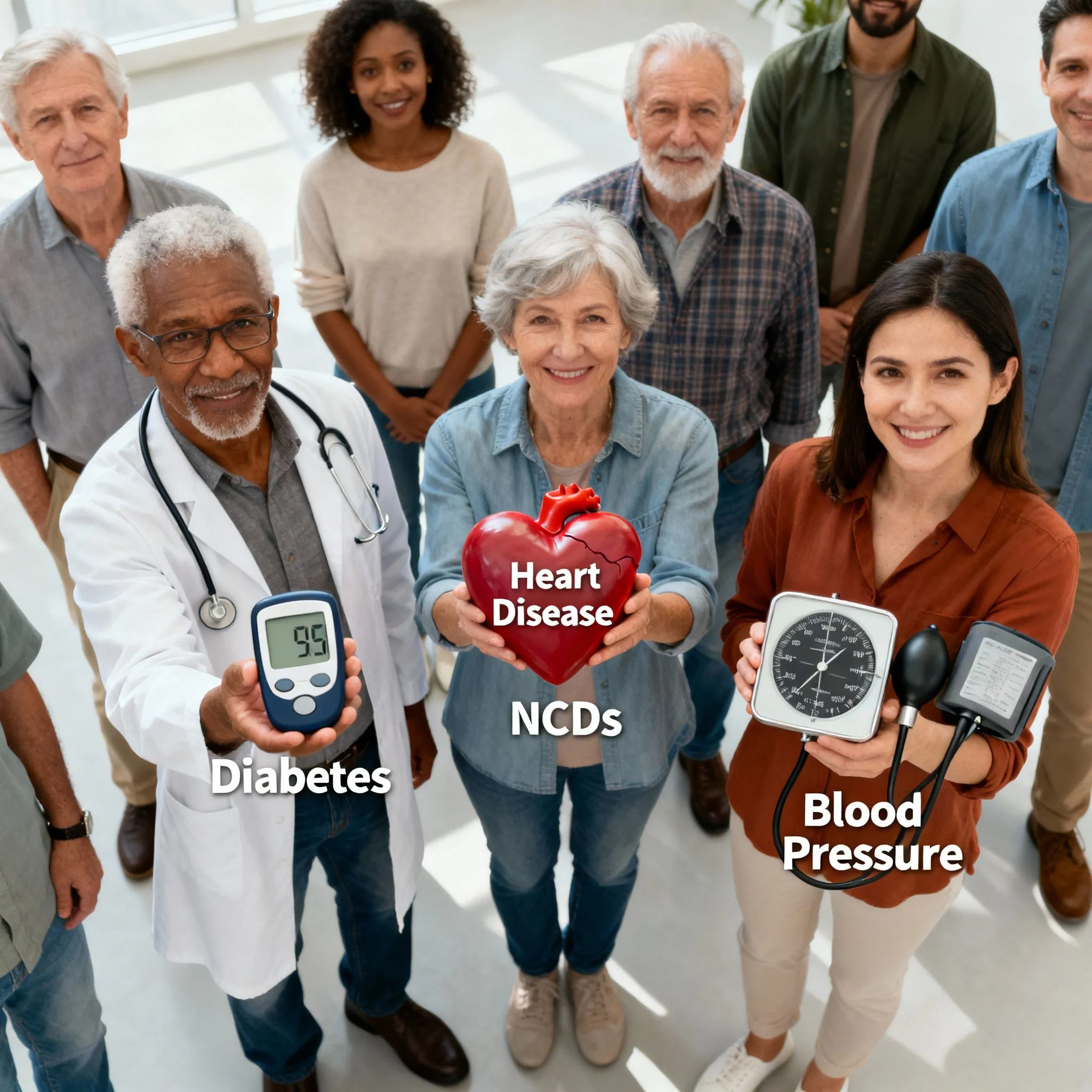
Noncommunicable diseases, or NCDs, include several groups of conditions such as diabetes, hypertension, heart disease, and cancer. Their causes and treatments differ, but they have something important in common: prevention, monitoring, and treatment often continue for years.
Continuity matters as much as any single appointment. When test results, medication lists, and visit histories sit in separate systems, clinicians may spend time reconstructing a record and patients may not remember every detail. Connected information can give an authorized care team better context and make changes over time easier to follow.
This article describes how data and health technology can support NCD care. It is not guidance for diagnosis or treatment changes. Patients should discuss their symptoms and care plans with a qualified healthcare professional.
The health and social burden of NCDs
The World Health Organization reports that NCDs caused at least 43 million deaths in 2021, equal to 75% of global deaths unrelated to the pandemic. The main groups are cardiovascular diseases, cancers, chronic respiratory diseases, and diabetes. This figure describes the worldwide burden. The Division of Non-Communicable Diseases publishes Thailand data by year and indicator.
The effects extend beyond an individual’s illness. Long-term treatment has costs, patients and families may lose working time, and health services must provide continuing follow-up. When a condition is detected late, treatment and rehabilitation can place a greater burden on both households and the health system.
Chronic care extends beyond one appointment
Managing a chronic condition can involve results collected at different times, medicines supplied by more than one provider, and observations made outside a clinic. A trend can be more informative than a single reading. Clinicians interpret that trend alongside the person’s history, symptoms, and circumstances.
NCDs result from a combination of genetic, physiological, environmental, and behavioural factors. WHO lists tobacco use, unhealthy diets, harmful alcohol use, insufficient physical activity, and air pollution among the major risks. These factors are associated with raised blood pressure, blood glucose, blood lipids, and obesity, but an individual’s risk still requires clinical information and professional advice.
Missing or delayed information can lead to repeated history taking or tests. This is partly a data problem and partly a workflow problem. A useful system must deliver information in a form the recipient can use, with its source, time, and scope intact.
Some conditions do not cause obvious symptoms at first. Appropriate screening and a record of change over time can help a care team recognize risk earlier. A system alert should prompt review rather than be treated as a diagnosis.
Data standards connect records at their source
HL7 FHIR R4 gives different health systems a shared structure for exchanging data. In HealthTAG’s architecture, hospital information enters the hospital’s FHIR Server through either a hospital-managed IT script or HealthTAG FHIR Transformer. The hospital remains in control of the clinical record.
Where an implementation supports it, authorized information such as encounters, medicines, or test results can appear in a PHR and help a patient follow their own history. The available data depends on the installation. Showing information in a PHR does not mean that the application diagnoses a condition or gives medical advice in place of a clinician.
Connected information still needs access controls
A combined view does not mean every system should have permanent access. HealthTAG separates record storage from authorization. Clinical records stay in hospital-controlled FHIR systems, while the authorization service checks a request against an access period defined from blockchain state.
Blockchain records consent and access events. It does not store test results or other clinical records. This keeps responsibility for the source record with the hospital while providing a history of how access rights were used.
How information can support prevention
NCD prevention involves appropriate screening, monitoring of risk factors, and follow-up based on professional advice. Technology can arrange observations along a timeline, help a person return to their results, or give a care team an authorized view of information from more than one source.
Information may come from hospitals, community clinics, or wearable devices that record activity and sleep. Within a suitable scope, analytical tools may help identify changes in glucose, blood pressure, or physical activity and prompt a patient or care team to review them. Consumer-device data needs a quality assessment before it is used for clinical care.
An analytical model or AI system should not be treated as a certain answer. Its output depends on complete, accurate, and appropriate data, as well as testing with the people it is intended to serve. Clinical decisions still belong to qualified professionals working with the patient.
At community level, appropriately aggregated data may help public agencies see patterns in heart disease, stroke, or risk factors across different areas. It can inform planning for screening, staffing, and budgets. Agencies still need to test data quality, protect privacy, and avoid treating a statistical association as the cause of disease.
AI, wearable devices, and population-level analysis are general HealthTech examples, not confirmed HealthTAG capabilities. HealthTAG’s current documented scope covers FHIR exchange, authorization checks, consent and access event records, and the PHR.
Patients authorize use. Hospitals safeguard records. Developers state the limits.
Patients should be able to understand what information they have authorized, who may use it, and for how long. Hospitals are responsible for the quality, security, and appropriate use of records under their control. System developers must describe their scope precisely and should not claim that connecting data alone prevents disease.
Continuous NCD care needs accessible services, clinicians with the right context, and patients who can take part in their care plans. Health technology can reduce information gaps when it supports real clinical work and preserves the patient’s rights at the same time.
Government, care providers, businesses, communities, and the public have different roles in NCD prevention and care. Technology should help services reach people who have difficulty accessing screening and follow-up. It should not widen the gap for people without devices, connectivity, or digital skills, so services need routes that do not rely on an app alone.
Data, technology, and NCD care
Responding to NCDs requires work before disease develops, throughout follow-up, and after an abnormal finding. Connected information can help patients and care teams understand history and trends. Public-health measures must also address risk factors and unequal access to care.
Information is useful when it is accurate, used under proper authorization, and connected to care that people can receive. Technology should support services and human decisions while patients, professionals, and health-system organizations retain their responsibilities.
Further reading
- Noncommunicable diseases, World Health Organization
- Division of Non-Communicable Diseases, Department of Disease Control
Sources
- Original article in the HealthTAG CMS archive (HealthTAG)
- Noncommunicable diseases fact sheet (World Health Organization)
- Division of Non-Communicable Diseases (Division of Non-Communicable Diseases, Department of Disease Control)