

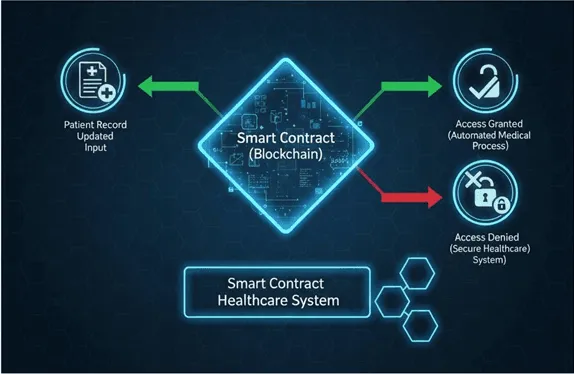
A smart contract is a program that evaluates conditions on a blockchain network. When its input matches a defined rule, the program records a state or triggers a prepared action. The name can sound like a legal agreement, but code cannot interpret intent, exceptions, or context on its own. Its behavior depends on the rules and information it receives.
Healthcare discussions often propose smart contracts for consent, payments, medicine supply chains, and research. HealthTAG currently uses them for authorization and access history.
How if-then rules work
A basic smart-contract condition can be written as “if this condition is true, perform this action.” For example, a system might accept the next step of a request if an authorization state remains valid. The network evaluates the agreed rule and keeps the resulting transaction in its history.
Consistency is useful when a rule can be defined precisely, but it does not prove that the rule itself is sound. Incorrect code, an unreliable source of input, or a missing emergency exception can all produce consistently wrong outcomes. Code review, input controls, and a recovery process remain necessary.
Consent and access authorization
Authorization state is the smart-contract use case most closely related to HealthTAG. A patient or another authorized process defines an access period, and the receiving system checks the state before releasing information.
In the current architecture, the authorization service checks a 15-minute window defined from blockchain state. After a successful check, it reads FHIR data from the hospital system. Blockchain records consent and access events, while clinical records remain in the hospital-controlled FHIR Server.
This is different from placing a medical record inside a smart contract. Clinical information is detailed, changes as care progresses, and remains under hospital control. The system sends it through an API after authorization instead of publishing it to a ledger.
Insurance claims depend on several connected systems
A smart contract could be designed to check policy data, treatment documentation, or approval status before starting a payment step. Blockchain cannot discover facts outside the network on its own. The design needs trusted data sources and a way to handle incorrect information, exceptions, appeals, and regulatory requirements.
A general example might begin when a hospital system sends diagnosis codes and billing items to a validation service. An oracle then supplies the required status to a smart contract, which compares it with the policy conditions. If the conditions are met, the system can start the next approval or payment step. Conflicting information should send the case to human review.
This design may reduce repeated document handling and rule checks. The actual time depends on the insurer, data quality, fraud controls, and applicable rules, so a system should not promise that every process will finish within minutes.
Smart contracts in supply chains and research
Similar rules could check medicine-transport conditions or record the completion of steps in a research project. Sensors, certifiers, and external processes still create the underlying facts. A smart contract only evaluates the information it receives.
In a supply chain, a rule might check that transport temperature remained within a defined range, a named body issued the required certificate, and the recipient confirmed delivery. The system could then release payment or record completion of that stage. This example depends on trustworthy sensors and certifiers because a smart contract cannot inspect the condition of a medicine by itself.
In research, a rule might record that a participant completed a scheduled study step and initiate compensation under the study agreement. Trial results still belong in a system designed for research data. Ethics approval, consent withdrawal, and correction of inaccurate information remain part of the study process.
The following are possible uses of smart contracts. They do not state that HealthTAG has a product, deployment, or collaboration in these areas.
Code does not replace human judgement
Automated rules suit conditions that can be measured and checked repeatedly. Healthcare also includes context that code may not see, such as an emergency, an identity mismatch, or an incomplete record. A responsible design names the accountable party and provides review and error-handling processes.
An auditable history does not mean every detail should be public. Developers should minimize what is recorded on blockchain, protect information in source systems, and limit access to what each role needs.
HealthTAG’s confirmed boundary
HealthTAG uses blockchain as a layer for authorization state and the history of consent and access. Hospitals still control clinical records. The authorization service checks access, and clinical information travels through a FHIR API only after the request has been authorized.
An accurate account of smart contracts states both what the code does and what remains outside it. A contract can make some rules consistent and auditable. It does not make every input correct, replace governance, or turn blockchain into a clinical-record store.
Further reading
- V. Singh and K. Sharma (2023), “The Role of Smart Contracts in Revolutionizing Healthcare Insurance Claim Processing,” as listed in the original archived article
- Smart contracts, Ethereum Foundation
- Oracles, Ethereum Foundation
Sources
- Original article in the HealthTAG CMS archive (HealthTAG)
- Smart contracts documentation (Ethereum Foundation)
- Oracles documentation (Ethereum Foundation)